
Defend, Educate, Inform
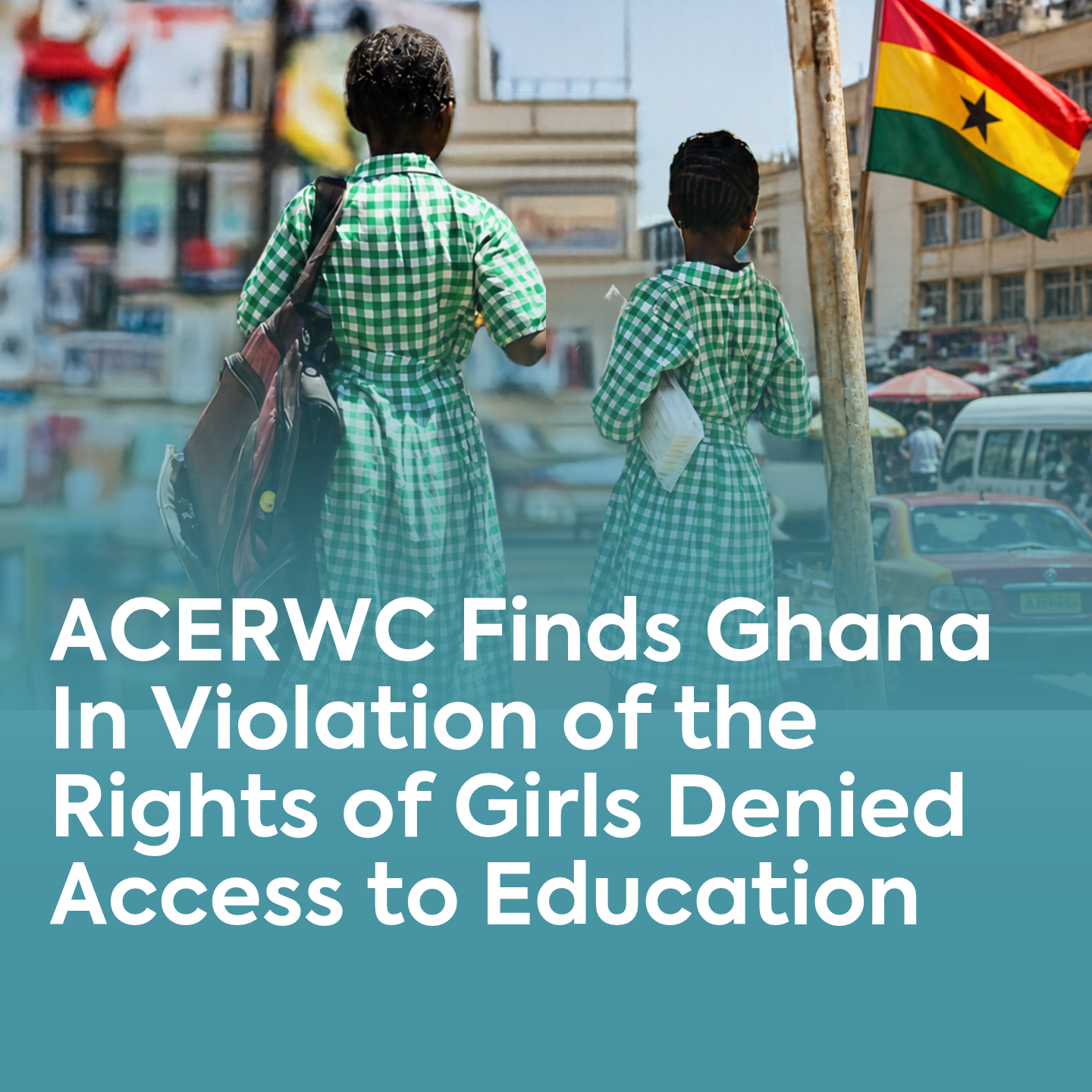
[Banjul, 6 November 2026] – The African Committee of Experts on the Rights and Welfare of the Child (ACERWC) has found the Republic of Ghana in violation of the African Charter on the Rights and Welfare of the Child in a decision concerning girls living in communities along the River Offin in the Ashanti Region.
The Communication concerned girls from the Ashanti Region communities who had to cross the River Offin to attend school in Kyekyewere Town, Upper Denkyira East Municipal District, in the Central Region. Under a customary practice observed in the affected communities, women and girls were prohibited from crossing the river on Tuesdays and during menstruation, based on beliefs that doing so could bring danger or death. Consequently, the girls lost between seven and twelve school days every month, with serious consequences for their education.
In the decision adopted on 20 October 2026 during the Committee’s 48th Ordinary Session in Maseru, Lesotho, the Committee, in Institute for Human Rights and Development in Africa and Solomon Joojo Cobbinah (on behalf of girls living in villages along River Offin in Ashanti Region) v Republic of Ghana, Communication No. 0019/Com/001/2022, found that Ghana violated the girls’ rights to education and non-discrimination, as well as its obligation to eliminate harmful social and cultural practices. The Committee also found that Ghana had failed to take adequate measures to address the discriminatory effects of the practice, despite its awareness of the situation. It emphasised that States have an obligation to protect children from harmful practices and discrimination, including where these arise from customary practices not directly created or enforced by State authorities.
The Committee recommended that Ghana expedite the construction of a permanent bridge across the River Offin, provide immediate safe crossing arrangements and introduce targeted sensitisation and training for teachers, education officials, affected girls and their families. It further recommended academic support for affected girls, appropriate examination arrangements, a review of policies that exclude smaller and remote communities from educational infrastructure, and sustained engagement with traditional authorities to address the harmful customary practice. Ghana is required to report to the Committee on the implementation of the recommendations within 180 days of receiving the decision.
Commenting on the decision, Dr. Abdulmalik Bello, a Legal Officer at IHRDA said: “We warmly welcome this important decision, which affirms that States must take concrete action to address discriminatory customary practices and protect girls’ rights. It is a significant affirmation of the rights to education and equality, and the obligation to eliminate harmful practices across Africa.”
The co-applicant in the case, Mr. Solomon Joojo Cobbinah, states: “No girl or woman should be prevented from crossing a river because it is Tuesday or because she is menstruating. This decision affirms a simple truth: culture must never be used to deny people their dignity, education, health care or freedom of movement. This is a victory for the girls whose voices have too often been ignored. But a decision on paper is only the beginning. It must lead to change in their daily lives.”
The decision reinforces the principle that States must do more than adopt laws and policies prohibiting discrimination: they must take practical, targeted and sustained action to ensure that every child can enjoy their rights in reality.
For further information, contact:
Maimouna Jallow
Communication and Publications Manager
Dennis Wangai Njoroge
Communication and Publications Officer
Institute for Human Rights and Development in Africa (IHRDA)
949 Brusubi Layout, AU Summit Highway,
P.O. Box 1896 Banjul, The Gambia.
Tel: +220 44 10 413/4
Cell: +220 87 77 51 200
Email: ihrda@ihrda.org