
Defend, Educate, Inform
By Solomon Ayele Dersso, Member of the African Commission on Human and Peoples’ Rights
The African Charter: Lodestar for the Africa we need and deserve
21 October 2026 marks the 40th anniversary of the entry into force of the African Charter on Human and Peoples’ Rights (African Charter). It is to be recalled that the African Charter was adopted during the 18th ordinary session of the Assembly of Heads of State and Government of the Organization of African Unity (OAU) on 27 June 1981 in Nairobi, Kenya after nearly two years of drafting. Four decades later as the quest for ‘justice, dignity, freedom and equality’ becomes more urgent and ferocious, the African Charter has emerged to be the lodestar for the Africa we need and we deserve.
In the annals of the history of international human rights instruments, the African Charter occupies a unique historical, political and symbolic significance of enormous global significance that far exceeds its continental scope. Like other similar instruments, it affirms, as part of the continental legal architecture and the corpus of international human rights, the pan-Africanist conviction that fundamental rights and freedoms should apply to all human beings. Going further, the African Charter imprinted those rights issues distilled from the continent’s experience of oppression and unfreedom into the tapestry of internationally recognised fundamental rights and freedoms.
This significance of the African Charter cannot be dissociated from the context and the historical background of the elaboration of the African Charter. History matters here as in other areas of law as it co-constitutes both the making of the Charter and today’s context that shapes the pursuit of its ideals. A doctrinal approach to the catalogue of rights, freedoms and duties articulated in the Charter offers us only a very limited understanding of both their meaning and content. It’s inadequate to capture their political, socio-economic and international importance vis-à-vis contemporary challenges of respect for and protection of human and peoples’ rights.
Historical and politico-legal significance of the African Charter
First, the African Charter represents an exercise of African agency in defining the essence and meaning of the rights that give full expression to Africa’s long struggle and aspirations for ‘dignity, freedom, equality and justice’, the ideals that underpin the African human rights system as clearly enunciated in the preamble to the Charter. The articulation of the African Charter made up for not only the lack of representation of the peoples of the continent in the drafting of the Universal Declaration of Human Rights (UDHR) but also for the failure of the UDHR to recognize foreign rule or colonial domination as the antithesis of human rights and hence manifestation of a lack of recognition of the inherent dignity and equal worth of people under colonial rule or foreign domination. Unlike the UDHR, which in its Article 2 proclaims the application of the rights in the Declaration irrespective of the status of a peoples as a subject of colonial rule, for peoples on the continent there could be no human rights without freedom from colonial rule or foreign domination. It is worth recalling that in Africa’s political history as far back as the 1919 Pan African Congress and the works of the foremost thought leaders including Frantz Fanon, Nnamdi Azikiwe and Kwame Nkrumah colonial rule and foreign domination were treated as negation of the very idea of human rights.
The African Charter thus affirms that human rights are not simply an embodiment of abstraction from an ideal theory about the human. Importantly, they are products of specific historical experiences and civilizations. In this sense, at one level the African Charter is an illustration of the late Christof Heyns theory of the struggle approach to human rights. Viewed from this perspective, the African Charter is in part an exercise to articulate catalogue of rights geared towards the conditions of oppression that historically robbed the peoples of the continent of their humanity as Africans and continue to impede their access to full measure of fundamental rights and freedoms. The African Charter thus gives recognition to the need to ‘eliminate colonialism, neo-colonialism, apartheid, Zionism, and to dismantle aggressive foreign military bases and all forms of discrimination, particularly those based on race, ethnic group, color, sex, language, religion or political opinion’.
Additionally, the African Charter addresses itself to the oppression of people in the hands of independent governments too. As such and second, the African Charter was also a response to, as one historical study on the political background of the African Charter put it, ‘the shame and embarrassment’ that some African leaders felt about the activities of some governments, in particular those of Amin, Bokassa and Nguema. This is best illustrated by what the Chairperson of the OAU President Tolbert of Liberia said in 1979 in his opening address to the AOU summit that mandated the preparation of the African Charter– ‘the principle of non-interference had become ‘an excuse for our silence over inhuman actions committed by Africans against Africans…The provisions concerning human rights must be made explicit.’ That this quest to pierce the veil of sovereignty and non-interference was a factor behind the OAU decision for the elaboration of a ‘Charter on Human and Peoples’ Rights’ was buttressed by the late Edem Kodjo, then the Secretary-General of the OAU. He said the African Charter ‘came about as the result of the ordeals which certain African peoples had suffered at the hands of their governments.’
It is worth recalling that the precedent that the African Charter set in piercing the veil of sovereignty & non-interference was subsequently expanded following the atrocious experience of the 1990s leading to the adoption under the AU Constitutive Act of the paradigmatically novel principle of intervention in cases of grave circumstances under Article 4 (h). The parallel becomes apparent from President Mandela’s speech during the 1994 OAU summit in Tunis where he expressed this sense of ‘shame and embarrassment’ when he said ‘Rwanda stands out as a stern and severe rebuke to all of us for having failed to address Africa’s security problems. As a result of that, a terrible slaughter of the innocent has taken place and is taking place in front of our very eyes.’
The continuity from the African Charter to the Constitutive Act reflects that Article 4(h) of the Constitutive Act built on the precedent set by the Charter, which laid down the foundation for the principle of non-indifference. One of the drafters of the African Charter, The Gambian jurist Hassan Jallow thus remarked in his book The Law of the African (Banjul) Charter on Human and Peoples’ Rights ‘the very notion of creating machinery for the promotion and protection of human rights was itself nothing less than revolutionary in a continent where and at a time when the African states were ultra-jealous of their national sovereignty even and brooked no interference in what they regarded as their internal affairs.’
The African Charter additionally represents an exercise of African agency in defining the essence and meaning of the rights that give full expression to Africa’s long struggle and aspirations for dignity, freedom, equality and justice. The Charter thus echoes the opening remarks of President Leopold Sedar Senghor at the first expert meeting for the drafting of the Charter in Dakar in 1979, where he counselled the experts to draw inspiration from and keep constantly in mind ‘our beautiful and positive traditions and civilization’ and ‘the real needs of Africa.’ The result of this has been not only the articulation of duties of individuals by the Charter premised on the Ubuntu philosophy of coexistence and harmony between the individual and the society, but also the recognition of the inseparability and interdependence of civil and political rights and economic, social and cultural rights.
In terms of ‘the real needs of Africa’, the African Charter accorded a prime place of honor to peoples’ rights on par with human rights as vividly captured in the title of the African Charter. In so doing, President Senghor pointed out, ‘We simply meant …to show our attachment to…rights which have a particular importance in our situation of a developing country.’ Elaborating further, he pointed out, ‘[w]e wanted to lay emphasis on the right to development and the other rights which need the solidarity of our states to be fully met: the right to peace and security, the right to a healthy environment, the right to participate in the equitable share of the common heritage of mankind, the right to enjoy a fair international economic order and, finally, the right to natural wealth and resources.’
While much of its promises have been honored by breach rather than compliance, the African Charter thus broke new ground in both the politico-legal evolution of the continent and international legal recognition of fundamental rights and freedoms. At the global level, it contributed to the enrichment of the international corpus of human rights. It did so both by giving equal legal status to civil and political rights on the one hand and economic and social rights on the other hand and by enshrining the collective rights of peoples and the duties of individuals.
The recent celebration of the international recognition of the right to environment by the UN Human Rights Council and the UN General Assembly highlights the significance of the African Charter, which gave recognition to this right four decades before this eventual international recognition, in setting the pace and being the first in rectifying some gaps in international human rights.
Normative successes and Contemporary significance of the African Charter
Today, the African Charter enjoys not only a status of customary international law but also that of being akin to the basic law of the continent. It is not simply one of the few OAU/AU treaties with near universal ratification. It is perhaps the only human rights instrument that is widely cited not only in large number of continental legal and policy documents but also at sub-regional and national levels. The African Charter also inspired the adoption of various human rights and democracy and governance norms within the OAU and its successor the African Union.
Along with other human rights instruments it inspired, the African Charter continues to serve as source of inspiration in the elaboration of national bills of rights and various laws giving effect to specific human rights. The African regional human rights system that the African Charter established also contributed to the recognition of the legitimacy of the works of civil society organizations, human rights defenders, political opposition and the media, despite the increasing assault to which they have in recent years been subjected. Within this framework, the African Commission has accorded institutional recognition by extending observer status to large number of non-governmental organizations working in the field of human rights pursuant to Article 45 (1)(c) of the African Charter.
The African Charter is not simply a historically grounded human rights treaty that speaks to both the generality of human rights issues and the human and peoples’ rights issues in Africa emanating from our specific historical experiences and socio-economic and political conditions. It is also a living document. As such and as enunciated in Article 45 (1) (b), it operates to respond to the human and peoples’ rights issues also of the present and the future. Additionally, in mandating the African Commission to apply the rights and duties in the Charter to specific cases that may be referred to the Commission by States or ‘other communications’, the Charter recognises the need for its constant interpretation and application to make the rights and duties in the Charter responsive to both the specific cases and the evolving needs of Africa. In commanding the African Commission under Article 60 to draw inspiration from international law on human and peoples’ rights, the Charter affirms its interconnectedness with international human rights. In doing so, the Charter also opens its provisions to be enriched through cross-fertilization.
Based on Articles 45 (1) (b), 47, 55 and 60 of the African Charter, the jurisprudence of the African Commission and since 2006 the African Court on Human and Peoples’ Rights, have clarified some of the gray areas in the African Charter and rectified the ‘claw back clauses’ attached to some of the rights in the Charter, which inspired the most criticism against the Charter in the early years of the Charter’s life.
The African Charter is unique in combining its particularistic and internationalist features in other ways as well. Thus, in articulating duties of individuals as embodying one of its distinguishing features, it states in Article 27 (1) that individuals owe duties, among others, to the international community. It is also unique in recognising international solidarity and the threat to human rights that international monopolies pose particularly in practicing what the Charter called ‘foreign economic exploitation’, signaling recognition of the human rights dimension of the operation of multinational corporations.
For the African Charter the authoritarian impulses of the state is only one (but never the only) source of threat to human rights and fundamental freedoms. As pointed out above, in the African experience, the historically grounded normative foundation for human and peoples’ rights has been the absence and deprivation of self-governing statehood to the peoples of Africa. The structural weaknesses and flaws that characterizes the post-colonial African state is a manifestation of the inherited burden from the process of the making of the colonial state. As Adom Getachew highlighted, in her landmark study Worldmaking after Empire: The Rise and Fall of Self-determination, this inherited burden makes ‘new and weak postcolonial states vulnerable to arbitrary interventions and encroachments at the hands of larger, more powerful states as well as private actors,’ thereby severely inhibiting their capacity for shouldering their responsibilities to meet the human rights needs of the peoples of the continent.
This is further aggravated by the place Africa is made to occupy in the power architecture of the international system, which the UN Secretary General characterised as being unfair, biased, morally bankrupt. In stating in the preamble that the peoples of Africa ‘are still struggling for their dignity and genuine independence,’ the African Charter is expressing its recognition of the impact of this unjust power arrangement of the international system. It thus affirmed that ‘it is henceforth essential to pay particular attention to development …and that the satisfaction of economic, social and cultural rights is a guarantee for the enjoyment of civil and political rights.’ These preambular statements and the substantive rights, in particular collective rights of peoples, expand the conception of injustice undermining the full enjoyment of human and peoples’ rights to encompass the ways in which the international system frustrates the rights of peoples to freely determine their economic and social development, on the basis of equity.
Is the generation marking the 40th anniversary of the African Charter betraying its mission?
This 40th anniversary of the entry into force of the African Charter is an occasion for thanksgiving for those who bequeathed us this fine African Charter. I wish in particular to pay homage to first the distinguished Senegalese Jurist Judge Keba Mbaye who, more than any other, played the role of being on the one hand a strategist and campaigner for securing the buy-in within the OAU of the idea of the African Charter and on the other hand the lead drafter of the African Charter. I also equally wish to extend our profound gratitude to President Leopold Sedar Senghor of Senegal and President Dawda Jawara of The Gambia for initiating the resolution for the adoption of the African Charter and for providing the guidance and support for the drafting of the African Charter. It is worth noting that Senghor’s opening address to the first expert meeting for the drafting of the African Charter served not only as the terms of reference but also as the intellectual guide for elaborating the contents of the Charter. Our deep gratitude also goes to the then Secretary-General of the OAU Edem Kodjo who threw his full weight behind the implementation of OAU Decision 115(XVI) mandating the drafting and worked tirelessly for its adoption.
In a memorable quote, Frantz Fanon in his most influential book the Wretched of the Earth, observed that ‘Each generation must, out of relative obscurity, discover its misison, fulfill it or betray it.’ The generation of Mbaye, Senghor and Kodjo discovered its mission and fulfilled it. We owe today’s celebration of the 40 years anniversary of the entry into force of our Charter to this.
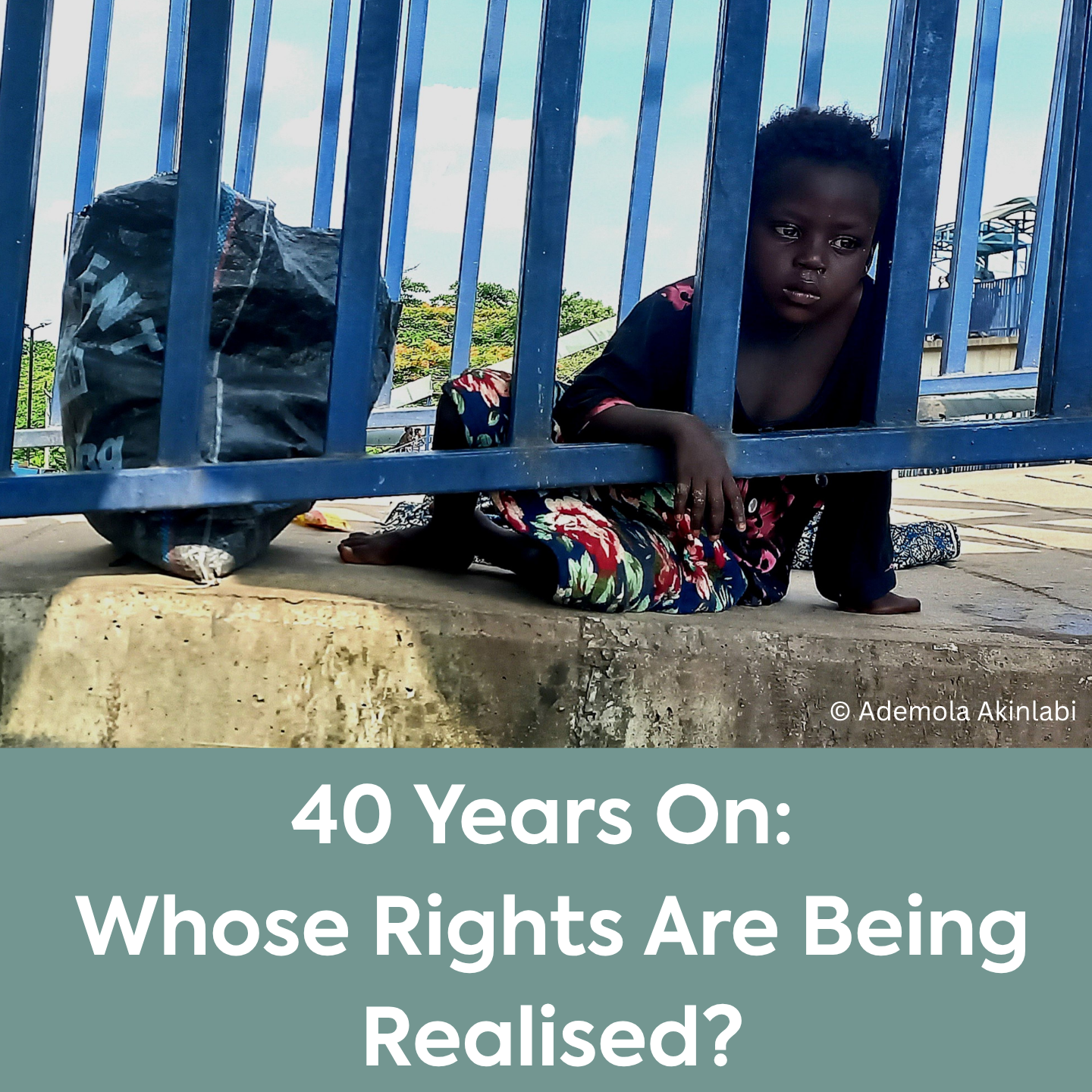
For the generation celebrating the 40 years of Our Charter, have we discovered our mission? Will we fulfil it, or betray it? As many who took the floor during the public segment of the 89th session of the Commission pointed out, the mission of this generation, to which we are all a part, lies in rendering the rights and freedoms of the African Charter meaningful in the lives of the masses of our peoples, i.e. empirically. Will we fulfill this mission by overcoming the challenge of implementation of the African Charter and by confronting the human rights challenges of our time namely – the deadly democratic governance deficit, widespread poverty and deepening inequality, pervasive gender oppression, the growing conflicts and violence and the climate emergency?
All the indications are that we are on course for betraying this mission. ‘How else can we explain the fact that in 2026 as in the 1990s we have the conditions which forced much more people than 90s ‘including women and children, into a drifting life as refugees and internally displaced persons, deprived of their means of livelihood, human dignity and hope’? How else can we explain nearly 40 million people and counting being displaced and forced to flee their country unless states are failing to shoulder their responsibilities under the African Charter? How can this be possible unless those entrusted with managing the affairs of our societies are betraying the trust of the public in pursuit of their own narrow self-interest thereby perpetuating the vicious cycle of misgovernance and authoritarianism? It is indeed an indictment on all of us that. How is it that while the resources of the continent are fueling the development of other parts of the world, we are not able to provide even for the most basic necessities of life for the masses of our people? What more represents the betrayal of the mission of this generation for translating the African Charter into reality than the way the Charter is observed by being routinely breached through not only the closing of the civic space, the assault on civil society, human rights defenders and the media but also the indiscriminate attacks against civilians and the display of complete lack of regard to the sanctity of human life in the various conflict settings on our continent and the attendant total impunity? What is more to show how the leaders of the continent are failing the public than the deepening sense of despair that is pushing our people, particularly the youth, to embark on the perilous journey across the Sahara to cross the Mediterranean Sea despite the death of no less than 20,000 migrants in only five years on this sea? It is indeed a betrayal of epic proportions that our societies could not assure women and girls a life free from violence so much so that there is no place, from home to the workplace and even places of worship, where they can feel safe and free from violence.
No doubt that the African Charter has come a long way in registering notable progress most normatively in entrenching rights in continental and national legal instruments, in inspiring new human rights instruments and the establishment of human rights institutions. Yet, not only that there is a long way before the promise of the Charter becomes a reality but also that notwithstanding the progress, in so many ways Africa is drifting away from the Charter, as rising poverty, unemployment, war and conflicts, restriction of civic space, digital repression and deepening governance deficits attest. As the various human rights issues canvased in the statements presented under agenda item 4 of the 89th session of the African Commission show, until we see the promise of the Charter empirically in the lives of the wretched of the continent, the poor, the displaced, the marginalised, the unemployed, and those deprived of health, education and equal protection of the law, our celebration will at best be partial, if not, misplaced.
Solomon Ayele Dersso, PhD, award winning human rights scholar and practitioner, is a former chairperson and current member of the African Commission on Human and Peoples’ Rights. A member of the editorial board of a number of peer reviewed law journals including African Human Rights Law Journal and Nordic Human Rights Journal, Dr Dersso serves as Adjunct Professor of Law at the University of Cape Town and Addis Ababa University.
Institute for Human Rights and Development in Africa (IHRDA)
949 Brusubi Layout, AU Summit Highway,
P.O. Box 1896 Banjul, The Gambia.
Tel: +220 44 10 413/4
Cell: +220 87 77 51 200
Email: ihrda@ihrda.org