
Defend, Educate, Inform
Seen, Heard and Engaged: From Reporting About to Reporting with Children
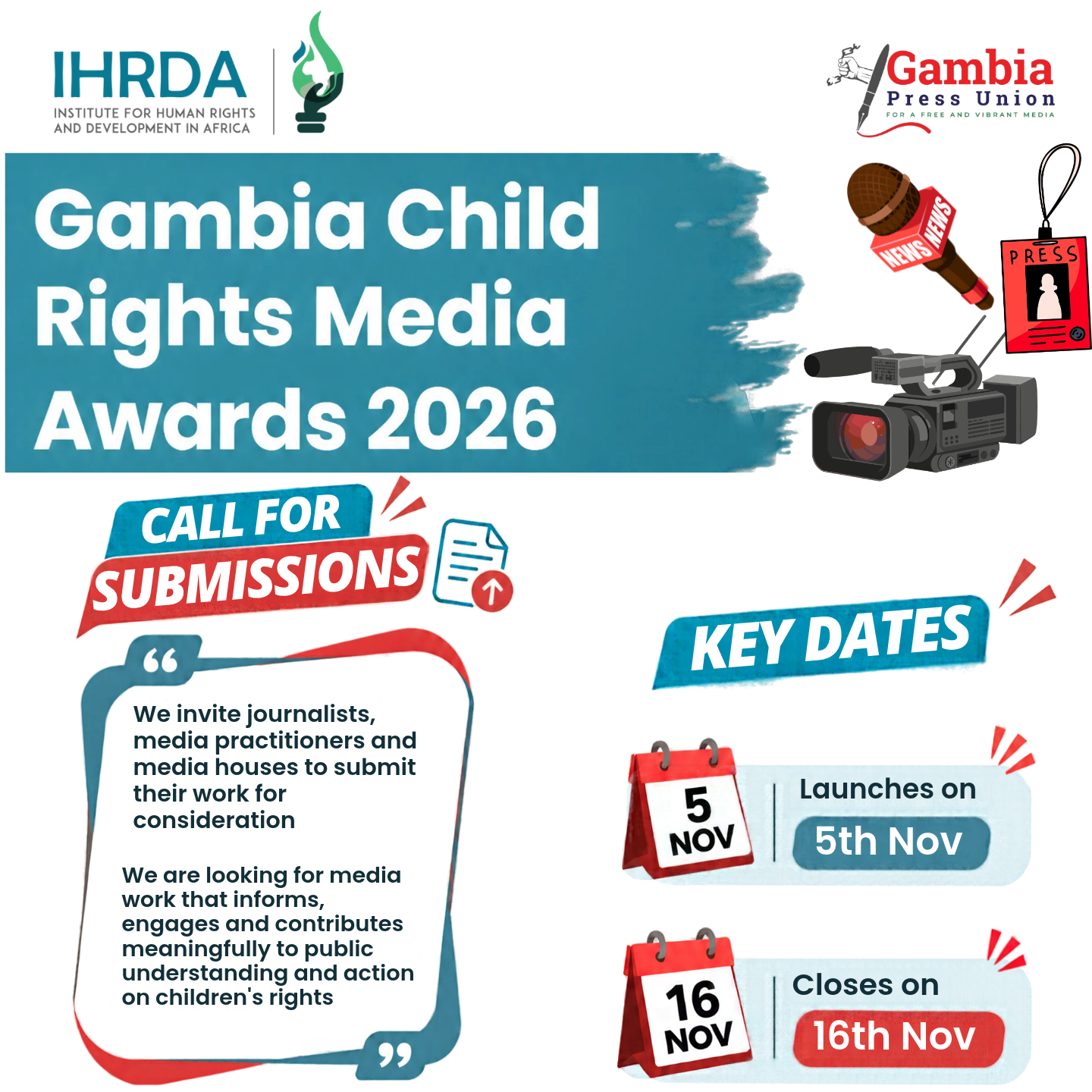
Gambia Child Rights Media Awards 2026
Recognising outstanding media content and engagement for children’s rights
Children’s rights deserve to be seen, heard and meaningfully represented in the media.
The media plays an important role in shaping public discourse, influencing social norms and drawing public attention to issues affecting children. In The Gambia, journalists and media outlets regularly report on issues such as education, health, child marriage, female genital mutilation (FGM), abuse and exploitation. Yet reporting about children does not always apply a child rights lens or adequately protect children’s dignity, privacy, safety and best interests.
This year the Institute for Human Rights and Development in Africa (IHRDA), with support from UNICEF The Gambia and in collaboration with the Gambia Press Union (GPU), will recognise outstanding media content and engagements that contribute to the promotion and protection of children’s rights in The Gambia. A dedicated The Gambia Child Rights Media Awards ceremony will be hosted on 1 December 2026.
We invite journalists, media practitioners and media houses to submit their work for consideration. Nominations may also be made by others with knowledge of the work. The awards will celebrate good practice, showcase high-quality child rights reporting and encourage continued ethical, accurate and child-centred media engagement.
What Are We Looking For?
We are looking for media work that informs, engages and contributes meaningfully to public understanding and action on children’s rights. Strong submissions may:
Award Categories
Best Print and Online Journalism: Outstanding articles, features, opinion pieces, investigative stories and other written journalism that meaningfully address children’s rights and, where appropriate, reflect children’s voices and perspectives.
Best Radio and Podcast Journalism: Compelling radio programmes, features, interviews, documentaries, podcast episodes or series that demonstrate ethical and meaningful engagement with children’s rights.
Best Radio Jingle on Children’s Rights: A creative, engaging and impactful radio jingle that raises awareness of children’s rights, promotes children’s participation or addresses issues affecting children in The Gambia.
Best Television and Video Journalism: Television reports, documentaries, interviews and other video-based stories that place children’s experiences, views and perspectives at the centre of reporting.
Best Journalism on FGM and Children’s Rights: Outstanding journalism addressing female genital mutilation (FGM) and its impact on girls and children, while meaningfully and ethically incorporating the voices, experiences and perspectives of children and young people.
Best Photography and Visual Storytelling: Powerful photographs and photo essays that highlight children’s rights and experiences while protecting children’s dignity, privacy, safety and best interests.
Who Can Submit?
The awards are open to:
Nominations are also welcome. Journalists, media houses, professional associations, civil society organisations or other individuals with knowledge of the work may nominate an eligible journalist, media practitioner or media house. The nominated work must still be submitted for consideration and meet the applicable eligibility and ethical requirements.
What Can Be Submitted?
Entries must consist of actual media content or documented media work/engagements relevant to the selected award category. Depending on the category, submissions may include:
Submission Requirements
Each submission must be made through the official awards submission form and include:
Important: A nomination or submission form alone is not sufficient. The actual media work being considered must be submitted or made accessible to the organisers and judging panel.
Ethical and Safeguarding Requirements
All submissions must comply with applicable ethical reporting and child safeguarding standards and uphold the dignity, safety, privacy and best interests of children.
What Makes a Strong Submission?
Entries will be assessed according to criteria appropriate to the relevant category, including:
Judging
Eligible submissions will be reviewed by an independent judging panel comprising individuals with relevant expertise in child rights, journalism and media, ethical reporting, safeguarding and communications. Judges will assess eligible submissions against the established criteria and select the award recipient in each category.
Awards and Recognition
Seven award recipients, corresponding to the seven award categories, will be recognised at the Gambia Child Rights Media Awards ceremony. Each awardee will receive a cash prize, an award crystal and a certificate of recognition.
How to Submit
Submissions must be made through the official awards submission form. Participants and nominators should complete all relevant sections of the form and provide the media work and supporting documentation required for the selected category.
Submission form: Click Here
Submission deadline: 16 November 2026
Enquiries: msaine@ihrda.org
Timeline:
| Activity | Date |
| Launch of Call for Submissions | 5th November 2026 |
| Submission Dealine | 16th November 2026 |
| Finalists Notified | 23rd November 2026 |
| Awards Ceremony | TBC |
Terms and Conditions
Originality and responsibility: Entrants and nominators are responsible for ensuring that submitted work is authentic and that they have the necessary authority to submit the work for consideration.
Copyright: Creators retain copyright in their work. By submitting an entry, participants grant IHRDA a non-exclusive, royalty-free licence to use shortlisted and winning work for communications, publications, advocacy, educational and reporting purposes, with appropriate credit.
Consent and safeguarding: Entrants and nominators are responsible for ensuring that appropriate consent and/or assent has been obtained where required, particularly where children are identifiable or their personal information or testimony is included.
Disqualification: The organisers reserve the right to exclude or disqualify submissions that are incomplete, ineligible, misleading or inconsistent with the awards’ ethical and safeguarding requirements.
Late submissions: Late or incomplete submissions will not be considered.
We invite the media community to help ensure that children are not only reported about, but are seen, heard and meaningfully represented in the stories that shape public discourse.
View Concept Note →
Institute for Human Rights and Development in Africa (IHRDA)
949 Brusubi Layout, AU Summit Highway,
P.O. Box 1896 Banjul, The Gambia.
Tel: +220 44 10 413/4
Cell: +220 87 77 51 200
Email: ihrda@ihrda.org