
Defend, Educate, Inform
Honourable Chairperson, Honourable Commissioners, Distinguished Delegates,
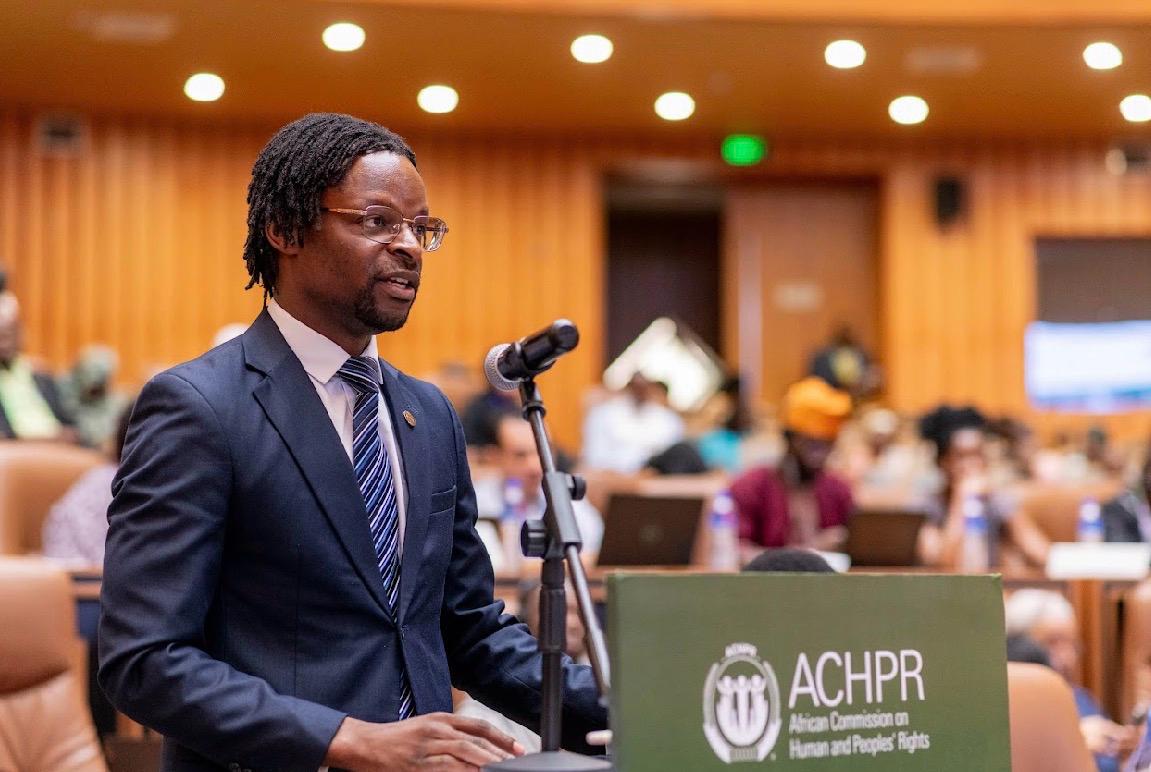
We thank you for the opportunity to speak at this 85th ordinary session of the Commission.
Honourable Chairperson,
The Institute for Human Rights and Development in Africa is deeply concerned by the ongoing conflict in Sudan and the Democratic Republic of Congo (DRC). These conflicts have resulted in massive displacement, systematic attacks on civilians, and grave violations of international human rights and humanitarian law. The Commission’s own Virtual Joint Fact-Finding Mission report on Sudan, launched at this 85th Ordinary Session, authoritatively documents serious and massive human rights violations, including indiscriminate attacks, extrajudicial killings, conflict-related sexual violence, and ethnically motivated atrocities perpetrated by both the Sudanese Armed Forces (SAF) and the Rapid Support Forces (RSF).
In light of these definitive findings, we urge the Commission to intensify its efforts to ensure the implementation of its own recommendations, and specifically to call on the warring parties to:
In eastern DRC, renewed fighting particularly in North and South Kivu provinces has displaced millions and left civilians facing daily violence. Recent reports now indicate that the crisis has created an alarming food emergency. Nearly 8 million people are now in acute food insecurity, with more than 2 million at risk of starvation. We urge the Commission to call on DRC to:
We would also like to draw the Commission’s attention to the violent dispersal of protests in Togo in June 2025. Reports suggest that unlawful killings, enforced disappearances, torture, and arbitrary detention, are part of a recurring pattern of repression in Togo, deliberately aimed at silencing dissent. The 2011 Law on Peaceful Assembly significantly restricts the right to peaceful assembly and gives the authorities broad powers to limit or ban public protests.
We urge the Commission to call on Togo to:
Further, we are alarmed by the severe environmental damage caused by mining and extractive industries on the continent. In Ghana illegal gold mining has led to the destruction of forests, farmlands and water bodies. Over 60% of Ghana’s water bodies are polluted, with many in critical condition. In the DRC, cobalt mining continues to contaminate water sources and destroy biodiversity. In Kabwe, Zambia, decades of lead and zinc mining have left a legacy of toxic waste. Over 100,000 residents, including children, suffer from lead poisoning. This has caused severe health issues in children, including developmental delays, learning difficulties, and long-term neurological damage.
We urge the Commission through its Working Group on Extractive Industries, Environment and Human Rights Violation to call on States to:
Recognizing the importance of holding State and non-State actors accountable for human rights violations, IHRDA commends the Joint Complementarity Retreat held with the African Court in June 2025, and welcomes the adoption of the Guidelines on Submission and Transfer of Cases. At a time when withdrawals from the Article 34(6) Declaration of the African Court Protocol pose a serious threat to access to justice on the continent, this decisive action to clarify the collaborative framework between the Court and the Commission is both timely and commendable. This step reaffirms the collective responsibility of both institutions to safeguard accountability and ensure access to redress. We urge the Commission to:
Finally, we remain deeply concerned about the persistent challenge of non-compliance by States with the decisions of the Commission. Limited implementation not only weakens the protection afforded to victims but also diminishes the effectiveness of the regional human rights system as a whole. Strengthening compliance is therefore not merely an administrative task, it is an opportunity to reinforce the authority of the Commission, consolidate the rule of law, and ensure that the rights guaranteed under the African Charter are given full and practical effect.
We therefore urge the Commission to:
Thank you for your attention.

Institute for Human Rights and Development in Africa (IHRDA)
949 Brusubi Layout, AU Summit Highway,
P.O. Box 1896 Banjul, The Gambia.
Tel: +220 44 10 413/4
Cell: +220 77 51 200
Email: ihrda@ihrda.org